




430F Stainless Steel Bar: AISI 430F Properties, Composition and Applications
The 430F bar is a free machining ferritic stainless steel. It has both good corrosion resistance and can be machined easily. As such, it is one of the most widely used free machining ferritic stainless steels. The 430F bar is designated as an AISI type 430F Stainless Steel and was developed specifically to provide the highest possible machining speeds and accuracies for precision manufactured parts.
What is 430F Stainless Steel Bar?
A 430F Stainless Steel Bar is an alternative to the 430 Grade Free-Machine Version. The 430 F is part of the Ferritic Family and can be referred to by the names of AISI 430F Stainless Steel, UNS S43020, and DIN 1.4104. The primary differences that exist between the Standard 430 Grade and the 430 F are primarily due to the addition of Sulfur. For detailed technical specifications, refer to the 430F stainless steel datasheet.
430F Stainless Steel Chemical Composition
The 430F composition is carefully balanced to provide corrosion resistance along with improved machinability, as specified in ASTM A582 (bar) and ASTM A479 (general use).
| Element | Composition % |
| Carbon (C) | 0.12 max |
| Manganese (Mn) | 1.25 max |
| Silicon (Si) | 1.00 max |
| Phosphorus (P) | 0.06 max |
| Sulfur (S) | 0.15 min |
| Chromium (Cr) | 16.0 – 18.0 |
| Iron (Fe) | Balance |
The higher sulfur content is the defining factor that enhances 430F machinability, though it slightly reduces corrosion resistance compared to standard 430.
430F Stainless Steel bar Mechanical Properties
The 430F material properties make it suitable for structural and mechanical applications requiring moderate strength.
| Property | Value |
| Yield Strength | 379 MPa min |
| Tensile Strength | 552 MPa min |
| Elongation | 25% min |
| Hardness (Brinell) | 262 max |
These 430F stainless steel properties provide a good balance of strength, ductility, and hardness for machined components.
430F Stainless Steel Physical Properties
| Property | Value |
| Density | 7.80 g/cm³ (0.282 lb/in³) |
| Thermal conductivity at 100°C | 26.1 W/m•K |
| Thermal conductivity at 500°C | 26.3 W/m•K |
| Specific heat capacity | 460 J/kg•K (0.46 J/g•°C) |
| Modulus of elasticity | 200 GPa |
| Electrical resistivity | 600 nΩ•m (0.60 µΩ•m) |
| Melting range | 1425–1510°C |
These 430F stainless steel properties provide a good balance of strength, ductility, and hardness for machined components.
Magnetic Properties of 430F Stainless Steel
One of the major 430F stainless steel magnetic characteristics is being extremely magnetizable in either the annealed or the cold worked state. Due to its crystal structure, 430F as a ferritic stainless steel has retained magnetism which makes it an ideal candidate for uses requiring some level of magnetic response (i.e., solenoids, electronic housing).
Machinability of 430F Stainless Steel Bar
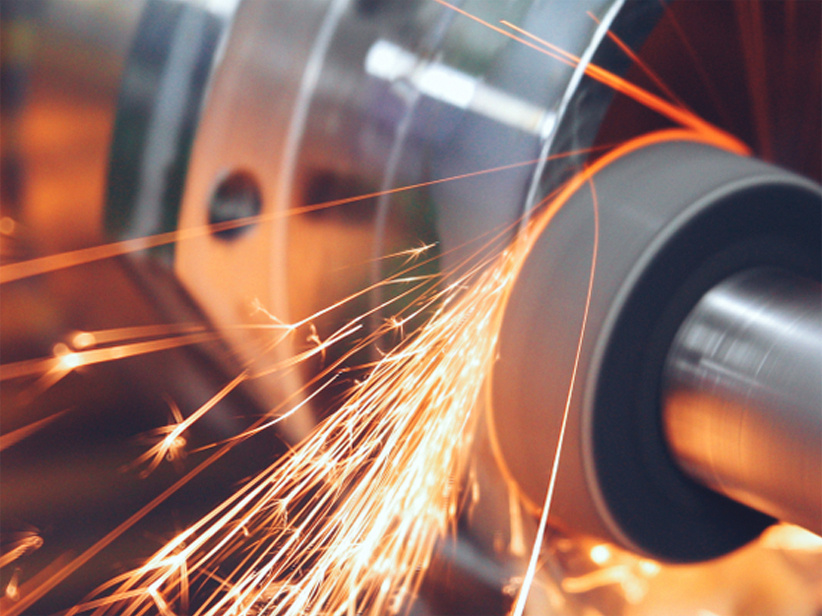
430F Machinability is one of its most significant benefits. The added Sulfur creates inclusions which are used as Chip Breaker. This provides easier cutting and lessened tool wear.
When compared to all other Stainless Steel types:
- Easier to Machine than Austenitic Grades such as 304
- Suitable for High-Speed Automatic Machining
- Provides Clean Finishes With Little Damage To Tools
This allows the 430F Stainless Steel Bar to be a first choice among many manufacturers who produce High-Volume Machined Parts.
430F Stainless Steel Working and Heat Treatment
Understanding the correct working temperatures and heat treatment procedures for 430F is essential for fabricators and machinists. The following covers hot working, cold working, annealing, and heat treatment for AISI 430F bar.
Hot Working
Preheat 430F stainless steel bar uniformly to 816°C (1500°F). Then raise the temperature slowly to the working range of 1066–1149°C (1950–2100°F). Do not work the material below 816°C (1500°F) while forging. After working, allow to air cool and anneal to relieve stresses.
Cold Working
Grade 430F can withstand moderate cold forming. The material exhibits lower ductility because of its ferritic structure and sulfur content which makes it less ductile than austenitic grades such as 304. The bend axis should be oriented perpendicular to the rolling direction because tight bends should be avoided to reduce the risk of cracking.
Annealing
Anneal 430F stainless steel bar at a temperature of 677–760°C (1250–1400°F) and air cool. For sub-critical annealing, heat to 760–815°C (1400–1499°F) and air cool or water quench. Slow cooling in the range of 400–600°C should be avoided as it causes embrittlement.
Heat Treatment
Grade 430F stainless steel cannot be hardened by heat treatment due to its ferritic body-centred cubic structure. Hardness can only be increased through cold working.
430F vs 416 vs 304 Stainless Steel - Key Differences
Given below is the comparison chart between 430F steel and the other two commonly specified grades, 416 steel (Martensitic Free Machining) and 304 steel (Austenitic General Purpose). This will help you choose the right grade.
| Property | 430F (this grade) | 416 | 304 |
| Steel family | Ferritic | Martensitic | Austenitic |
| Chromium content | 16–18% | 12–14% | 18–20% |
| Machinability | Excellent | Excellent | Moderate |
| Corrosion resistance | Moderate | Low to moderate | High |
| Magnetic | Yes — strongly | Yes | No |
| Weldable | Not recommended | Difficult | Yes |
| Hardenable by heat treatment | No | Yes | No |
| Typical uses | Fasteners, solenoids, valve components, screw machine parts | Aerospace fittings, shafts, gears needing hardness | Food equipment, marine, chemical plant, welded assemblies |
Choose 430F over 416 when your application requires moderate corrosion resistance with strong magnetic response and no need for hardening. Choose 416 when the component must be hardened by heat treatment for higher strength. Choose 304 when weldability and maximum corrosion resistance are the priority and magnetism is not required. If your application requires a ferritic free-machining grade instead of martensitic, see our guide comparing 430F vs 416 stainless steel.
Applications and Uses of 430F Stainless Steel Bar
Thanks to good machinability and a fair amount of corrosion resistance, 430F has been used in many different fields:
- Automotive Components (Shafts, Bolts, Nuts)
- Electrical and Electronic Parts
- Fasteners and Fittings
- Pumps and Valve Components
- Appliance Parts
The 430F Stainless Steel Bar is also especially beneficial when you need both high precision machining and low costs.
430F Stainless Steel bar Available Sizes and Forms
Venus Wires supplies 430F stainless steel bar in the following standard forms and sizes. Custom dimensions and cut-to-length are available on request. Contact our sales team for availability and current pricing.
| Bar Form | Standard Size Range | Available Finishes |
| Round bar | 3 mm to 500 mm diameter | Black, bright, polished, No.4 |
| Hex bar (A/F) | 5 mm to 100 mm across flats | Bright, cold drawn |
| Flat bar | 2 mm to 150 mm thickness | Black, bright polished |
| Square bar | 5 mm to 100 mm | Black, polished |
430F Bar Specifications and Equivalent Grades
The AISI 430F stainless steel grade is recognized across global standards:
| Standard | Designation |
| UNS | S43020 |
| DIN | 1.4104 |
| JIS | SUS 430F |
| BS | 430S15 |
| ASTM | A276, A479, A582 |
| AFNOR | Z 13 CF 17 |
These equivalents ensure easy sourcing and compatibility in international projects.
Why Choose Venus Wires for 430F Stainless Steel Bar?
To obtain reliable, consistent high-quality 430F Stainless Steel Bar you will need to find a reputable manufacturer in India. Venus Wires is a manufacturer with a history of being a source that can be relied upon for:
- Metals manufactured according to International Standards
- High quality Raw Materials
- Reliable Advanced Manufacturing Processes
- A Wide Range of Sizes and Finishes
- Global Reach with Reliable Supplies
Venus Wires provides reliable Solutions for Industries that require Performance and Precision.
Frequently asked about 430 F Stainless Steel Bar
430F Stainless Steel Bar is utilized for Machining Applications like Fasteners, Shafts, Valves and Automotive Components. The reason behind this is that 430F has an Excellent Machinability.
The main differences is sulfur content. 430F contains more sulfur than standard 430. This causes 430F to be more machinable and less corrosion resistant than the standard 430.
Yes. It is Strongly Magnetic because of Ferritic Structure.
No. Due to High Sulfur Content welding is Not Recommended. This results in Cracking and Low Weld Quality.
430F Bars are Available in Wide Range of Diameters and Finishes Based on Supplier Capabilities and Application Requirements.
The density of 430F stainless steel is 7.80 g/cm³ (0.282 lb/in³). This is consistent with other ferritic stainless steels in the 400 series and is slightly lower than austenitic grades such as 304, which has a density of 7.93 g/cm³. The lower density can be a marginal advantage in weight-sensitive precision machined components.
Grade 430F stainless steel cannot be hardened by heat treatment. Its ferritic body-centred cubic structure does not undergo the phase transformation required for hardening. Hardness can only be increased through cold working. Annealing at 677–760°C (1250–1400°F) followed by air cooling is used to relieve stresses and restore ductility after machining or cold forming.
Both 430F and 416 have similar machinability properties due to their addition of sulfur. However, the main distinction lies in their family structures; 430F is ferritic in nature and has good machinability but cannot be hardened, possesses moderate corrosion resistance, and is very magnetic, while 416 is a martensitic type which can be hardened by heat treatment and has less corrosion resistance.
Conclusion
430F stainless steel bar is very well suited for precision applications because of its reliability, good mechanical strength and high level of machinability. For consistent quality and dependable supply of this material to all parts of India and overseas, Venus Wires continues to be the preferred supplier of many industries.
- Metals manufactured according to International Standards
- High quality Raw Materials
- Reliable Advanced Manufacturing Processes
- A Wide Range of Sizes and Finishes
- Global Reach with Reliable Supplies
Venus Wires provides reliable Solutions for Industries that require Performance and Precision.